Article: Buying a Chess Set: What Actually Matters
Buying a Chess Set: What Actually Matters
One chess set costs fifteen dollars. Another costs six hundred. Both have sixty-four squares and thirty-two pieces. So where exactly is the difference — and which one is worth it to you?
The question has a real answer, once you know what to look for. Before buying a chess set, there are five things worth knowing: material, size, pieces, craftsmanship, and storage. Everything else is taste.
1. The material: solid wood or veneer
The biggest difference is in the wood itself. A solid wood board has real weight on the table, makes a satisfying sound when a piece is set down, and ages beautifully over decades. Veneered chipboard can look identical in a photo — but the veneer lifts over time, edges chip, and what should have been a keepsake ends up in a landfill. More on this in our article Solid Wood or Veneer: The Difference You Only Notice Later.
The simple test: pick the board up. Solid wood feels different. It has a weight that can't be faked.
2. The size: square size and king height need to match
This is where most people go wrong. A beautiful board and beautiful pieces don't automatically make a good set — the proportions have to work together.
The simple formula: square size = king height × 0.55. A 3.75-inch king (about 95 mm) needs a square of roughly 2 inches (about 52 mm). Standard USCF tournament sets use a similar ratio, with squares between 2 and 2.5 inches for a king around 3.75 inches — explained in detail in Chess Board Size: Square Size & King Height.
At home, you don't need to follow this to the millimeter. But when pieces are too large, the board feels cramped and you knock over neighboring pieces when you move. Too small, and they look lost on the board.
3. The pieces: weight decides how the game feels
Good chess pieces are weighted — metal set into the base, felt underneath. This does two things: the piece stands firm and won't tip if you brush against it, and it feels substantial in your hand when you move it. More in Weighted Chess Pieces: Why Weight Determines How the Game Feels.
Pay attention to the shape as well. The standard is the Staunton design — used worldwide, in every club, for over 150 years. Ornate fantasy pieces look striking on a shelf but play worse, because they're harder to tell apart at a glance.
4. Craftsmanship: the details you notice later
Barely visible at purchase, impossible to miss after five years:
- Rounded edges — sharp edges chip and feel cheap over time
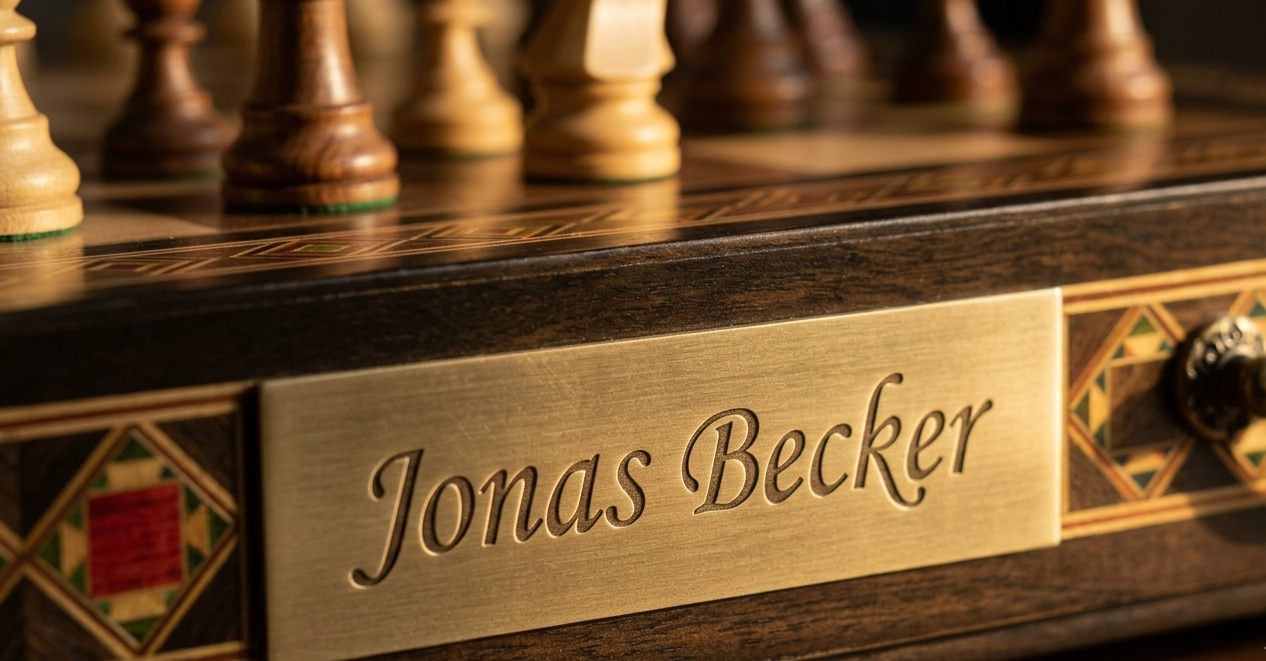
- Clean square joins — good inlay work means every square sits precisely, with no visible seams
- Matte rather than glossy finish — high gloss reflects light and tires the eyes during long games
- Felt on the piece bases — protects the board from scratches
To understand the difference between real handwork and mass production in more depth, see Handcrafted or Mass-Produced: How to Actually Tell the Difference.
5. Storage: where do thirty-two pieces go?
A point almost everyone overlooks. If you don't want your set permanently set up, you need somewhere for the pieces to live. A cloth bag works, but lets pieces rub against each other.
A chess box is more elegant: board and storage in one, with a compartment or insert for every piece. The set stays complete, protected, and ready to play — and it looks good on a shelf even when it's not in use.
What the price actually buys
Fifteen dollars buys a game. A handcrafted set in solid wood buys an object that stays. The rules are identical on both boards — the difference is whether you're still sitting at it in twenty years. A full cost breakdown is available in Why Is a Chess Set Expensive? The Cost Breakdown, and what actually makes a set "premium" in What Really Makes a Chess Set Premium?.
Anyone who also wants tournament-level standards will find the complete Tournament-Ready Checklist in its own article.
Schachatelier: at home in Berlin
Schachatelier is at home in Berlin. Every set is genuinely handcrafted by experienced makers — in solid wood, with weighted pieces and proportions that work together. On request, we engrave a personal dedication into the wood at no extra cost.
→ Explore handcrafted chess sets
Frequently Asked Questions
What should I look for when buying a chess set?
Five things: solid wood rather than veneer, matching proportions between square size and king height, weighted pieces in the Staunton design, clean craftsmanship with rounded edges, and thoughtful storage.
Which square size matches which king height?
The rule of thumb: square size = king height × 0.55. A 3.75-inch (95 mm) king pairs with a square of roughly 2 inches (52 mm). Standard tournament sets typically use squares between 2 and 2.5 inches.
Why does one chess set cost fifteen dollars and another six hundred?
The difference comes down to material, construction, and finishing: solid wood instead of chipboard, handwork instead of mass production, weighted pieces, precise inlay work. A cheap set does the job; a well-made one lasts for decades.